
Quick Answer
Mahalo is a Hawaiian word that means “thank you.” It also carries deeper shades of meaning: gratitude, appreciation, admiration, and respect. It is pronounced mah-HAH-loh, it is polite but friendly, and anyone can use it respectfully. To say “thank you very much,” say mahalo nui loa.
Key Takeaways
- Mahalo means “thank you,” but traditionally it also expresses admiration, esteem, and appreciation.
- It comes from the Hawaiian language (ʻŌlelo Hawaiʻi), a Polynesian language, and is tied to the Hawaiian value of showing regard for people and the world around you.
- Pronunciation: mah-HAH-loh, with the stress on the middle syllable and every vowel pronounced clearly.
- Mahalo nui loa means “thank you very much.”
- It works in almost any setting, from a cafe counter to a formal speech, so it is neither strictly formal nor strictly casual.
- Common replies include “You’re welcome,” “ʻAʻole pilikia” (no problem), and “Aloha.”
- Visitors are welcome to use it, as long as they say it sincerely and pronounce it with care.
- Common myth: the word “mahalo” on Hawaii trash bins does not mean “trash.” It is a thank-you to the person using the bin.
- Mahalo is not the same as aloha. Aloha covers love, hello, goodbye, and compassion. Mahalo is specifically about gratitude and appreciation.
What Does Mahalo Mean?
If you have ever visited Hawaii, watched a show set on the islands, or seen a sign at a beachside restaurant, you have probably come across the word mahalo. At its simplest, mahalo is how people in Hawaii say thank you. It is short, warm, and easy to remember, which is why it has become one of the best-known Hawaiian words in the world.
But mahalo is more than a translation of “thanks.” In Hawaiian, the word reaches toward appreciation, admiration, and respect. When someone says mahalo to you, they are not only acknowledging what you did. They are also recognizing you, your effort, and your kindness. That extra layer of meaning is a big part of why the word feels so different from a quick, automatic “thanks.”
Mahalo Meaning in English
In English, mahalo is most often translated as:
- Thank you
- Thanks
- Gratitude
- Appreciation
In Hawaiian dictionaries, the word is also associated with ideas such as admiration, praise, esteem, and regard. It works both as an expression (“Mahalo!”) and, in traditional usage, as a word describing the feeling behind it. So depending on the context, mahalo can be understood as “I thank you,” “I appreciate you,” or “I admire what you have done.”
In practice, for travelers and learners, the safe and accurate translation is simply “thank you.” The deeper meanings are useful to know, because they explain the tone people expect when the word is used.
Where Does the Word Mahalo Come From?
Mahalo belongs to ʻŌlelo Hawaiʻi, the Hawaiian language, which is part of the Polynesian branch of the Austronesian language family. Hawaiian shares ancestry with languages such as Tahitian, Māori, Samoan, and Tongan. Many Hawaiian words have relatives across the Pacific, and linguists generally link mahalo to a wider family of Polynesian words relating to thought, regard, and admiration rather than only to saying thanks.
This background helps explain why mahalo has always been about more than politeness. Its roots lie in the idea of thinking well of someone, of holding another person in esteem. Over time, expressing that feeling out loud became the everyday way of saying “thank you.”
The Hawaiian language nearly disappeared in the twentieth century after decades of suppression, but a strong revival movement, including Hawaiian-language immersion schools, has brought it back. Words like mahalo have remained in daily use throughout that history, which is part of why they carry such cultural weight today.
What Does Mahalo Mean in Hawaiian Culture?
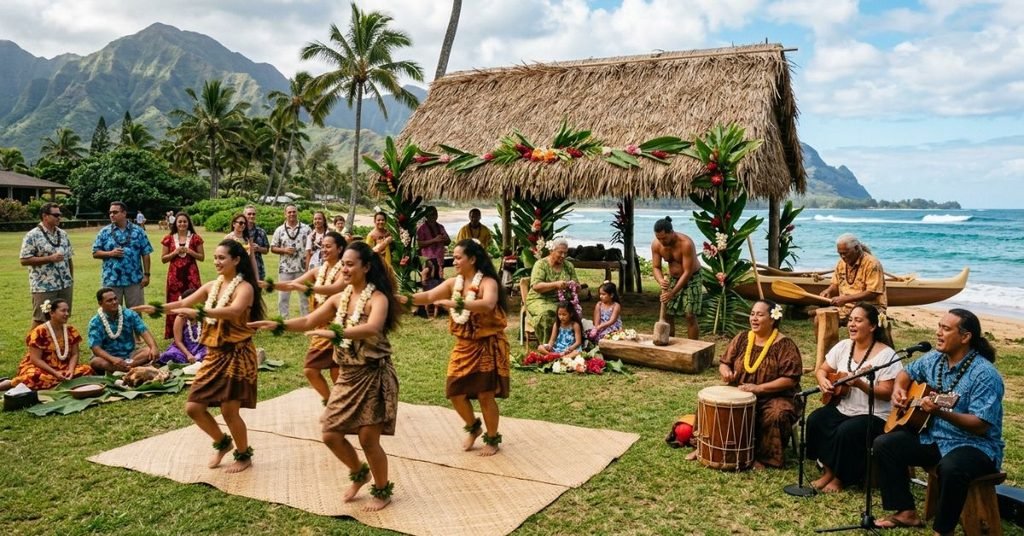
In Hawaiian culture, gratitude is not a minor courtesy. It is part of how relationships, families, and communities are kept healthy. Values such as aloha (love, compassion, and care), ʻohana (family), kuleana (responsibility), and malama (to care for) all connect to the idea of giving and receiving with respect.
Mahalo fits into this web of values. Saying it acknowledges that:
- Someone has given you their time, food, knowledge, or help.
- You recognize and respect that gift.
- You are part of a community in which people look after one another.
Gratitude in Hawaii also extends beyond people. Hawaiians have long expressed thanks to the land (ʻāina), the ocean, ancestors, and the natural world for providing food, shelter, and life. In that sense, mahalo is both a social courtesy and a reflection of a worldview built on reciprocity and respect.
How Is Mahalo Pronounced?
The correct pronunciation is mah-HAH-loh.
Here is a simple breakdown:
| Syllable | Sounds like | Notes |
|---|---|---|
| ma | “mah” | Like the “ma” in “mama” |
| ha | “HAH” | The stressed syllable, like “ha” in “ha-ha” |
| lo | “loh” | Like “low,” with a clean “oh” sound |
A few tips:
- Stress the middle syllable. It is mah-HAH-loh, not MAH-ha-loh.
- Pronounce the “h” softly but clearly. Do not drop it.
- Keep the vowels pure. Hawaiian vowels are short and clean, so the “o” at the end should not turn into a drawn-out “ow” sound.
- Do not rush it. A relaxed, friendly pace sounds most natural.
There is no ʻokina (the glottal stop mark) in “mahalo,” so there is no pause inside the word. It flows smoothly from start to finish.
When Do People Use Mahalo?
People in Hawaii use mahalo the same way people elsewhere use “thank you,” which is to say, all the time. You might hear it when:
- A server brings your food
- A stranger holds a door open
- A guide shares local knowledge
- A host welcomes you into their home
- A speaker wraps up a talk and thanks the audience
- A shop clerk hands you your change
It is as natural in a busy grocery store as it is in a formal ceremony. The word is woven into daily life on the islands.
Mahalo as a Way to Say Thank You
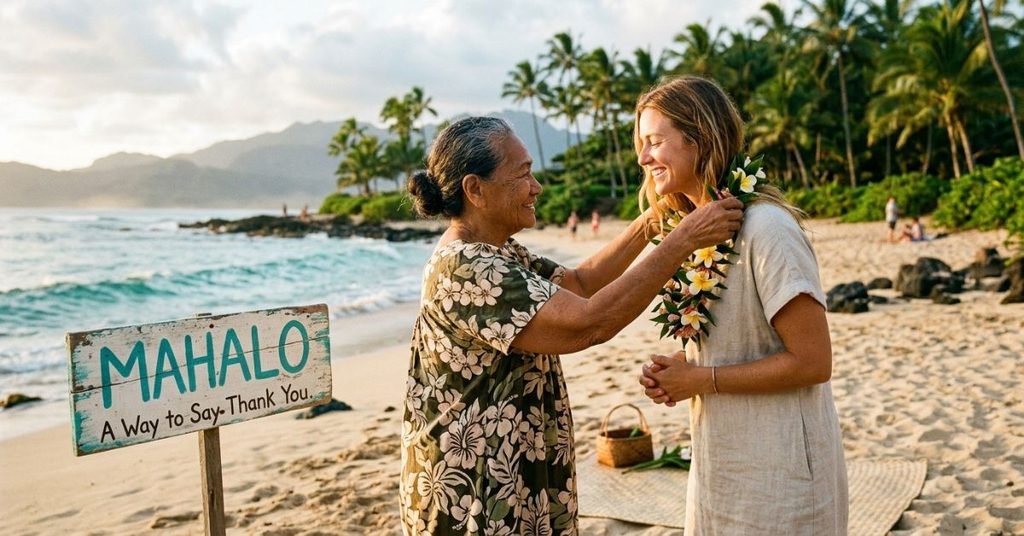
As a plain thank-you, mahalo works on its own:
- “Mahalo!”
You can also add detail by using a short phrase after it:
- “Mahalo for your help.”
- “Mahalo for dinner.”
- “Mahalo, this is delicious.”
In Hawaiian, you can also say “Mahalo iā ʻoe” (thank you, to you), and in longer expressions, “Mahalo nō” is used to say “thanks for” something. Many visitors simply stick with “mahalo” or “mahalo nui loa,” which is perfectly fine.
Can Mahalo Mean More Than “Thank You”?
Yes. Although “thank you” is the everyday meaning, mahalo can also express:
- Admiration: appreciating someone’s skill or character
- Praise: acknowledging someone’s good work
- Respect: recognizing someone’s role or contribution
- Deep appreciation: a heartfelt thanks beyond a quick courtesy
For example, when a community thanks a teacher or an elder, the word carries more weight than a casual “thanks.” The same word can be light and cheerful at a coffee shop and solemn and heartfelt at a memorial or ceremony. The meaning is shaped by tone, context, and sincerity.
Common Situations Where You Might Hear Mahalo
You will hear mahalo in many places across Hawaii and beyond:
- Restaurants and cafes: from servers, cooks, and cashiers
- Hotels and resorts: at check-in, at the concierge desk, and on signs
- Airports and airlines: in announcements and on boarding signage
- Tours and activities: from guides at the end of a hike, snorkel trip, or cultural experience
- Public spaces: on trash bins and signs thanking people for keeping places clean
- Community events: at festivals, school performances, and fundraisers
- Family gatherings: when sharing food, gifts, and stories
The word is so common that after a few days on the islands, many visitors find themselves saying it without thinking.
Mahalo in Everyday Hawaiian Conversation
In daily life, mahalo often shows up as part of a short, friendly exchange. Locals may blend Hawaiian words with English or Hawaiian Pidgin (also called Hawaiʻi Creole English), so you might hear mahalo dropped easily into an English sentence. A few relaxed examples:
- “Mahalo for the ride, brah.”
- “Mahalo, you made my day.”
- “Hey, mahalo for bringing the food.”
In Pidgin, people sometimes say things like “mahalo plenty” for “thanks a lot,” and “mahalos” as a plural noun, meaning a few thanks or expressions of gratitude.
The tone tends to be warm and unhurried. Eye contact, a smile, and a friendly voice are as much a part of saying mahalo as the word itself.
Mahalo vs. Thank You: What’s the Difference?
On the surface, the two are interchangeable. Underneath, there are subtle differences:
| Mahalo | Thank you | |
|---|---|---|
| Language | Hawaiian | English |
| Core meaning | Thanks, plus admiration and esteem | Thanks, acknowledgment of a favor |
| Cultural context | Tied to Hawaiian values of respect and reciprocity | General, used worldwide |
| Tone in Hawaii | Warm, personal, community-minded | Polite, sometimes routine |
| Usage | Everyday and ceremonial | Everyday and formal |
Neither is “better.” The difference is that mahalo carries the flavor of Hawaii, and using it, when done sincerely, shows awareness of and respect for the place you are in.
Different Ways to Use Mahalo in a Sentence
Mahalo is flexible. It can stand alone or be extended:
- Alone: “Mahalo!”
- With a reason: “Mahalo for the directions.”
- With emphasis: “Mahalo nui loa.”
- With a person: “Mahalo, Keoni.”
- In writing: “Mahalo for your support.”
- With a gesture: a smile, a nod, or a shaka (the hand gesture with thumb and pinky extended) in casual settings
It is also used as a noun in English: “She gave me her mahalo,” meaning her thanks. You may hear this in casual speech, though the simple exclamation is far more common.
Examples of Mahalo in Conversations
At a restaurant
Server: Here’s your plate lunch. Guest: Mahalo! Server: You’re welcome. Enjoy!
After getting directions
Visitor: Is the beach that way? Local: Yes, just past the second stoplight. Visitor: Mahalo nui loa for your help. Local: No problem. Have a great day.
At a hotel
Guest: Could I get an extra towel? Front desk: Of course, I’ll send one up. Guest: Mahalo. Front desk: ʻAʻole pilikia. (No problem.)
In a work email
“Thank you all for joining today’s meeting. Mahalo for your hard work on this project.”
Between friends
Friend A: I saved you a seat. Friend B: Mahalo, you’re the best!
How to Respond When Someone Says Mahalo
You have several options, from simple to traditional:
- “You’re welcome.” This always works and is entirely appropriate.
- “ʻAʻole pilikia.” (ah-OH-leh pee-lee-kee-ah) means “no problem” or “no trouble.”
- “Aloha.” Because aloha carries warmth and goodwill, it is a gracious reply.
- “Mahalo to you, too.” Good when the gratitude goes both ways.
- “My pleasure.” Friendly and widely understood.
- A smile and a nod. In casual situations, this is often enough.
Do not worry about being perfect. A sincere, friendly response matters more than precise Hawaiian.
Also Read! IKTR Meaning: What Does IKTR Stand For?
Is Mahalo Formal or Informal?
Mahalo is both. It is one of the rare words that fits almost anywhere:
- Informal: chatting with friends, buying a coffee, thanking a neighbor
- Semi-formal: emails, customer service, presentations
- Formal: speeches, ceremonies, official acknowledgments, printed programs
To adjust the level of formality, change the wording around it rather than the word itself. “Mahalo!” is casual. “Mahalo nui loa for your generous support” is more formal and heartfelt.
Common Phrases That Include Mahalo
| Phrase | Meaning |
|---|---|
| Mahalo | Thank you |
| Mahalo nui | Thanks a lot / thank you very much |
| Mahalo nui loa | Thank you very much (the most emphatic common form) |
| Mahalo iā ʻoe | Thank you (to you) |
| Mahalo nō | Thanks for (something) |
| Mahalo plenty | Thanks a lot (Pidgin and local English) |
| Mahalo for visiting | A common tourism message |
| Mahalo for your support | Common in business and community settings |
If you are just starting out, mahalo and mahalo nui loa are the two you need.
What Does “Mahalo Nui Loa” Mean?
Mahalo nui loa means “thank you very much.”
- Mahalo = thanks
- Nui = big, great, or much
- Loa = very, long, or extremely
Put together, it is an emphatic, heartfelt thank-you. Use it when someone has gone out of their way for you, such as a host who cooked a meal, a guide who gave you a memorable day, or a stranger who helped you during a problem. It is the Hawaiian equivalent of “thank you so much” or “I really appreciate it.”
The pronunciation is mah-HAH-loh NOO-ee LOH-ah.
Mahalo in Hawaiian Tourism and Hospitality
Hawaii’s visitor industry uses mahalo constantly. You will see it on hotel welcome cards, restaurant receipts, shop bags, airline announcements, and signs at attractions. It often appears alongside “aloha” to create a warm, welcoming tone.
There is a real value in this. When mahalo is used sincerely by hosts and guests alike, it reinforces a culture of mutual respect. But many Hawaiian cultural practitioners also remind visitors that the word should not become a slogan with no meaning behind it. The best hospitality uses the word the way it is meant: as a genuine acknowledgment of the people and places that make a visit possible.
For travelers, a few easy ways to show real mahalo include thanking staff by name, following local guidance, respecting sacred sites, and leaving natural places as you found them.
The Cultural Importance of Saying Mahalo
Saying mahalo matters for several reasons:
- It honors relationships. Acknowledging others strengthens community.
- It reflects humility. Gratitude recognizes that no one succeeds alone.
- It supports language and culture. Every respectful use of a Hawaiian word helps keep it visible and valued, particularly given how close the language came to being lost.
- It connects people to place. Gratitude to the land and sea is part of living well in Hawaii.
In a world where thanks can become automatic, mahalo offers a reminder to slow down and mean it.
Common Misunderstandings About the Word Mahalo
Myth 1: “Mahalo” means “trash.” Many visitors see the word on trash bins and assume it names the bin. In fact, the sign is thanking you for using it.
Myth 2: Mahalo means the same thing as aloha. Aloha covers love, affection, compassion, hello, and goodbye. Mahalo is about thanks and appreciation.
Myth 3: Mahalo is only for tourists. Residents use it every day in every setting. It is authentic, not merely a tourist phrase.
Myth 4: Only native Hawaiians can say it. It is a living word used by people of many backgrounds in Hawaii. Respectful use is welcome.
Myth 5: The pronunciation does not matter. It does. A small effort to say it correctly (mah-HAH-loh) shows care.
Myth 6: You must always say “mahalo nui loa.” Plain “mahalo” is usually enough. Save the longer form for when you want to add emphasis.
Is Mahalo Appropriate for Non-Hawaiian Speakers?
Yes. Hawaiians and longtime residents generally welcome visitors using mahalo, especially when it is said sincerely. The word is part of everyday life in Hawaii, and using it is usually taken as a sign of respect rather than appropriation.
What matters is the spirit in which it is used:
- Say it with real gratitude, not as a joke or gimmick.
- Pronounce it carefully.
- Avoid using Hawaiian words as decoration on products or costumes without any understanding or connection.
- Pair the word with real respect for Hawaiian culture, people, and places.
Learning a few words is a good way to start a deeper appreciation of the language.
Mahalo has easily moved online. You will see it in:
- Captions: “Mahalo for an amazing trip 🌺”
- Comments and replies: “Mahalo for sharing!”
- Texts: “Mahalo 🤙” (the shaka emoji is a popular companion)
- Business posts: small businesses in Hawaii often thank customers with mahalo
- Hashtags: #mahalo appears on travel, gratitude, and community posts
- Email sign-offs: “Mahalo,” in place of “Thanks,” or “Best regards,”
It works well in digital settings because it is short, friendly, and memorable. Just remember that online, too, the word lands best when it is sincere and not thrown in automatically.
Mahalo in Hawaiian Music, Art, and Popular Culture
Mahalo appears across Hawaiian music, hula, visual art, and storytelling. Musicians often thank audiences with the word at the end of a performance, and hula events often include expressions of gratitude to teachers (kumu), ancestors, and the land. Local artists use the word in prints, murals, and designs that celebrate island life.
In wider popular culture, mahalo has shown up in films, television, travel writing, and brands. That visibility has helped spread the word worldwide, though it has also led to some overuse in commercial contexts. The most meaningful appearances of mahalo are still the ones rooted in genuine community, culture, and gratitude.
Mahalo vs. Other Hawaiian Words of Appreciation
Hawaiian offers other words and ideas connected to gratitude and goodwill:
| Word | Meaning | How it differs from mahalo |
|---|---|---|
| Mahalo | Thank you, gratitude, admiration | The everyday word for thanks |
| Aloha | Love, affection, compassion, hello, goodbye | Broader; not specifically “thank you” |
| Maikaʻi | Good, well, fine | Used to praise or affirm something as good |
| Pono | Righteous, proper, in balance | A value of doing right, not a thank-you |
| Malama | To care for, to protect | An action of care rather than an expression of thanks |
| ʻOhana | Family | The relationship behind much of the gratitude |
If your goal is to say thank you, mahalo is the word. The others enrich the picture of how Hawaiians think about care, goodness, and community.
Tips for Using Mahalo Respectfully
- Mean it. Say it when you feel grateful, not as filler.
- Practice the pronunciation. Mah-HAH-loh. Say it a few times before you travel.
- Match the moment. Use “mahalo” for quick thanks and “mahalo nui loa” for bigger favors.
- Add eye contact and a smile. The tone is as important as the word.
- Learn a reply. Knowing “ʻaʻole pilikia” makes the exchange feel more natural.
- Thank specific people. “Mahalo for showing us around, Kai” lands better than a generic thank-you.
- Respect the culture behind the word. Learn about Hawaiian history, language, and values, and support Native Hawaiian businesses and organizations.
- Do not treat it as a novelty. Avoid mocking accents or using the word jokingly.
- Back it up with action. Follow local rules, care for the land, and be a considerate guest. That is the truest form of mahalo.
Frequently Asked Questions About Mahalo
What does mahalo mean?
Mahalo means “thank you” in Hawaiian. It also conveys gratitude, appreciation, admiration, and respect.
How do you pronounce mahalo?
It is pronounced mah-HAH-loh, with the stress on the middle syllable.
What does “mahalo nui loa” mean?
It means “thank you very much.” Nui means “big” or “much,” and loa adds emphasis.
Is mahalo a Hawaiian word?
Yes. It comes from ʻŌlelo Hawaiʻi, the Hawaiian language, and is related to words in other Polynesian languages.
Does mahalo mean “trash”?
No. On trash bins in Hawaii, it is a thank-you to the person using the bin, not a name for it.
Is mahalo the same as aloha?
No. Aloha means love, compassion, hello, and goodbye. Mahalo means thank you.
Can tourists say mahalo?
Yes. Visitors are welcome to use it, especially when they say it sincerely and pronounce it respectfully.
How do you reply to mahalo?
Say “You’re welcome,” “ʻAʻole pilikia” (no problem), “Aloha,” or “My pleasure.”
Is mahalo formal or casual?
It is both. It suits casual chats, business emails, and formal ceremonies.
Can I use mahalo in writing?
Yes. It is common in emails, cards, captions, and speeches. “Mahalo” as a sign-off is friendly and warm.
Is it “mahalo” or “mahalos”?
“Mahalo” is used for both singular and general thanks. “Mahalos” appears informally as a noun in local speech, such as “big mahalos to everyone.”
What is the best way to show mahalo beyond the word itself?
Act with respect: care for the land, follow local customs, support local people and businesses, and express thanks to those who help you.
Final Thoughts on the Meaning of Mahalo
Mahalo is a small word with a large meaning. On the surface, it is a simple way to say thank you. Beneath it lies a tradition of admiration, respect, and reciprocity that has shaped life in the Hawaiian Islands for generations. It works in a coffee shop, a classroom, a boardroom, and a ceremony. It travels well, too, appearing in texts, emails, and social posts around the world.
If you take one thing from this guide, let it be this: mahalo is best when it is meant. Say it clearly, say it kindly, and let it reflect real appreciation for the people, places, and culture that inspired it. Do that, and you will be honoring the word exactly as it was meant to be used.
Mahalo nui loa for reading.