
Key Takeaways
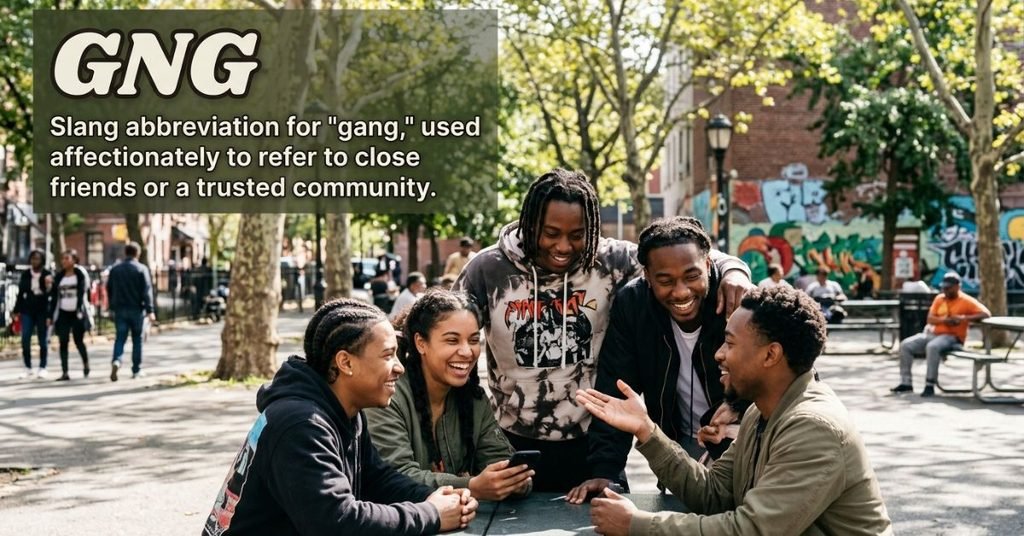
- GNG is a shortened spelling of “gang,” used to affectionately refer to close friends or a trusted community.
- It’s used differently across platforms — TikTok and Instagram lean toward “friend group,” while gaming chats often use it to mean “go next game.”
- In fast texting, GNG can also just mean “going,” with no friend-group meaning at all.
- It’s casual internet slang, so it’s best kept out of professional or formal writing.
- Context — who’s saying it, where, and what’s around it — is the fastest way to know exactly what someone means.
If you’ve spent any time scrolling through TikTok comments, Instagram captions, or group chats lately, chances are you’ve bumped into the letters “GNG” and wondered what on earth they mean. Maybe a friend texted “love you gng 💙” and you had no idea how to respond. Maybe you saw it under a gaming clip and assumed it was some kind of inside joke. You’re not imagining things — GNG has become one of the most widely used abbreviations in modern digital conversation, and understanding it is genuinely useful if you want to keep up with how people talk online today.
This guide breaks down everything about GNG: what it means, where it came from, how it’s used across different platforms and communities, the situations where it can mean something completely different, and how to use it yourself without looking like you’re trying too hard.
What Does GNG Mean?
At its core, GNG is a compressed spelling of the word “gang.” It’s built using a common trick in internet slang called vowel deletion — the vowels are stripped out of a word to make it shorter and quicker to type, while the consonant skeleton keeps it recognizable. “Gang” becomes “GNG” the same way other words get squeezed down in texting culture.
But GNG doesn’t carry the meaning most people associate with the word “gang” in a legal or criminal sense. In online slang, it has been reshaped into something much warmer. It refers to your close circle of friends, your squad, your ride-or-die crew — the people you trust and consider your own little community. When someone calls you “gng,” they’re essentially saying you belong, that you’re part of their inner circle.
Think of it as sitting in the same family of words as:
- Fam — short for family, used to describe close friends
- Squad — a group of close companions
- Bro or sis — used to address someone with familiarity and warmth
- Homies — an older but related term for close friends
GNG slots into that same emotional space. It’s less formal than “friend” and carries more warmth and closeness than a simple greeting.
GNG Meaning in Texting
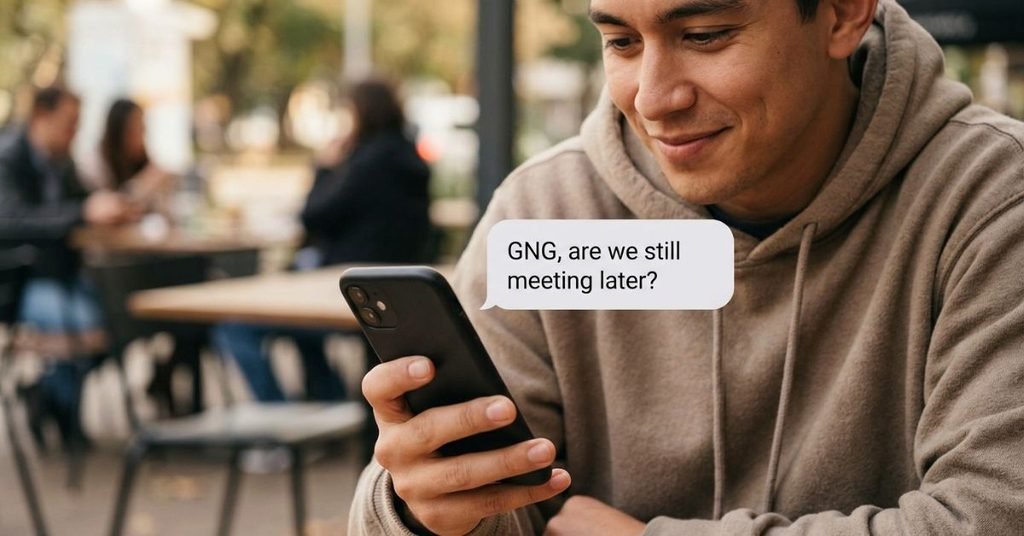
In text messages specifically, GNG almost always shows up in casual, friend-to-friend conversations rather than formal or professional ones. It works as a quick way to refer to your close circle without typing out the full word, and it fits naturally into the fast, back-and-forth rhythm of texting.
A few common ways it shows up in texts:
- “gng u up?” — asking your friend group if anyone’s awake or available
- “miss the gng fr” — expressing that you miss your friends, often after time apart
- “pulling up with the gng” — letting someone know you’re showing up with your friend group
- “gng.” — sent alone, often as a quick acknowledgment or a casual way of saying “yeah, we’re good” or wrapping up a conversation
In texting specifically, tone can be harder to read than on public platforms like TikTok or Instagram, since there’s no wider audience or visual context to lean on — just you and the other person. Because of this, GNG in a text thread is best interpreted based on your relationship with the sender and the conversation leading up to it. Between close friends, it almost always reads as warm and casual. Sent by someone you barely know, it can feel a little more ambiguous, and might be worth a quick clarifying question if the meaning isn’t obvious.
It’s also worth noting that texting is where the alternate “going” meaning shows up most often, since it’s purely a fast typing shortcut rather than a cultural slang term. A message like “omw, gng now” leans toward “going” simply because of the sentence structure around it — there’s no friend-group context, just an action being described.
The Origins of GNG
To understand GNG, it helps to look at where the word “gang” itself comes from. Historically, “gang” simply meant a group of people who moved or worked together — it wasn’t inherently negative. Over the 20th century, the word picked up strong associations with organized criminal groups, which is the meaning many older generations still default to when they hear it.
But language evolves, and younger generations — particularly those who grew up immersed in hip-hop culture, gaming communities, and social media — began reclaiming “gang” as a term of affection and loyalty rather than criminality. Rappers and musicians popularized phrases like “my gang” to refer to their close collaborators and friends, and that usage trickled into everyday youth culture.
As texting and social apps exploded in popularity, brevity became currency. Every extra keystroke costs time, and platforms like Twitter historically rewarded short, punchy phrasing. Vowel-dropping became a widespread technique across slang — think “sry” for sorry, “thx” for thanks, or “btw” for by the way. Applying that same logic to “gang” naturally produced “gng.”
By the early 2020s, GNG had firmly planted itself in the vocabulary of Gen Z and younger millennials, spreading rapidly through TikTok comment sections, Instagram captions, Snapchat stories, and Discord servers. Today it’s less a “new” slang term and more an established part of the modern digital lexicon.
How GNG Is Used in Real Conversations
Context is everything with GNG. The word itself is simple, but the tone and situation shape exactly what it’s communicating. Here’s a closer look at the most common real-world patterns.
💙 A Term of Endearment for Friends
“Miss you gng 💙”
Simply put, this means “I miss you, friend.” It’s affectionate and casual, most often used in captions or comments directed at close friends.
👋 A Way to Address a Group Collectively
“What’s up gng, welcome back!”
Content creators frequently use GNG to speak to their entire audience at once, almost like calling their followers “family.” Instead of treating viewers as a faceless crowd, this phrasing turns them into an extended community.
🤝 An Expression of Loyalty or Solidarity
“Real gng only.” / “Gng over everything.”
Phrases like these emphasize loyalty to one’s close circle, prioritizing genuine relationships over surface-level acquaintances.
✌️ A Casual Sign-Off
“Alright gng, catch you later.”
Some people use GNG as a short, casual goodbye in a group chat, essentially standing in for “talk to you later, everyone.”
🔥 A Caption or Comment Tag
“Gng 🔥” / “Gng 💯”
On TikTok and Instagram, you’ll frequently see GNG used as a standalone comment under posts — usually paired with emojis — as a quick way of showing support or camaraderie without needing to type out a full sentence.
Platform-by-Platform Breakdown
Slang doesn’t always mean the exact same thing everywhere, and the way GNG is used can shift slightly depending on which platform you’re on.
TikTok
This is arguably where GNG sees the heaviest usage of any platform. Comment sections are packed with it, often used by creators addressing their community or by fans showing solidarity with a creator or with one another.
Frequently appears in captions, especially from creators or influencers referring to their audience as an extended friend group. It’s also common in comments under posts featuring friend groups.
Snapchat
Tends to be used in a more personal, one-on-one sense — pointing to a specific close friend or a small private circle rather than a wider public audience.
Discord and Gaming Chats
This is where things get a little more complicated, since GNG can take on an entirely different meaning depending on the community (covered in more detail later in this guide).
Twitter/X
Used similarly to TikTok and Instagram, often dropped into replies or quote posts as a quick way to show camaraderie or agreement with a poster’s community.
WhatsApp and Group Texts
Sticks close to the casual friend-to-friend usage, referring directly to the friend group itself — as in “gng dinner this weekend?”
When GNG Means Something Else Entirely
Here’s where it gets interesting: while “gang” is by far the dominant meaning, GNG isn’t a one-size-fits-all abbreviation. Depending on the setting, it can shift into something else entirely, and misreading the context can genuinely lead to confusion.
⌨️ “Going” in Fast Typing
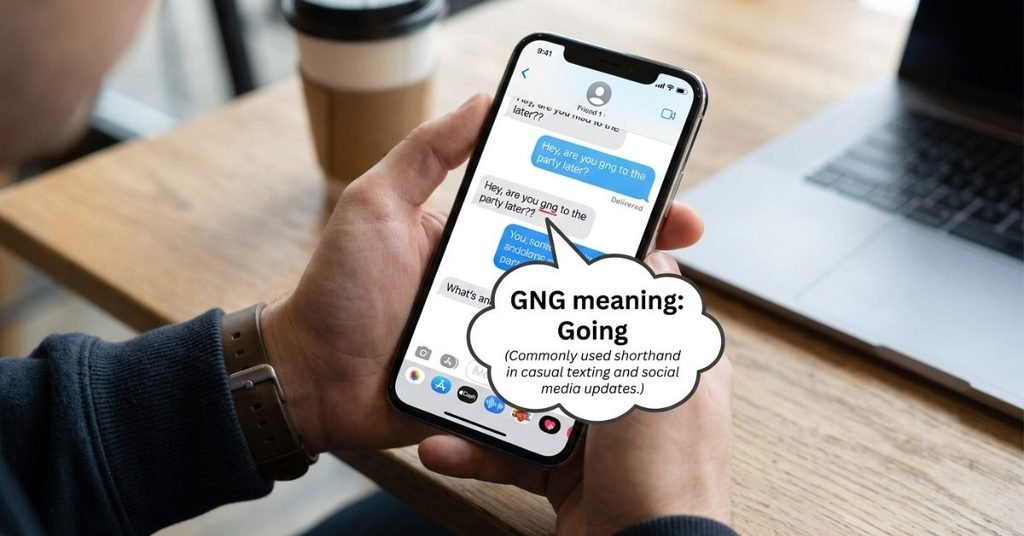
In some casual texting contexts, especially when speed matters more than precision, people type “gng” as a shorthand for “going.” A message like “I’m gng to the store” uses GNG purely as a compressed spelling of an action word, with no reference to friend groups at all. This usage tends to show up more in quick, informal one-on-one texts than in public posts.
🎮 “Go Next Game” in Gaming Communities
Among gamers, particularly in competitive titles, GNG can mean “go next game.” After a match ends — especially a loss — players might type “gng” in chat to signal that it’s time to move on and queue up for the next round rather than dwelling on the result. If someone comments “GNG” under a clip of you losing a match, they’re probably not calling you their friend — they’re telling you to shake it off and move forward.
🌙 “Good Night, Gang”
In some group chats, especially among close friend circles, GNG occasionally gets used as a shorthand sign-off meaning “good night, everyone,” blending the affectionate “gang” usage with a bedtime farewell.
📋 Formal or Technical Acronyms
Outside of internet slang entirely, GNG also exists as a legitimate acronym in unrelated fields — for example, it has been used as shorthand in certain aviation, medical, and organizational contexts. These meanings are highly specific to their industries and essentially never overlap with how GNG is used in casual online conversation, but it’s worth knowing they exist if you ever encounter the letters outside of a social media context.
💡 The Golden Rule: When you see GNG, look at who’s saying it, where they’re saying it, and what’s happening around it. A gaming clip, a heartfelt caption, and a rushed text message will each point you toward a different meaning.
Is GNG Offensive or Inappropriate?
Generally speaking, no — in its dominant internet-slang usage, GNG is friendly, casual, and carries positive connotations of closeness and loyalty. It’s roughly as informal and harmless as saying “squad” or “fam.” That said, a few things are worth keeping in mind before using it freely in every setting.
Because GNG derives from the word “gang,” older generations or people unfamiliar with the slang might initially misread it as a reference to criminal activity. Context usually clears this up quickly, but it remains a reasonable source of confusion in cross-generational conversations, especially when someone encounters the term for the first time without any surrounding explanation.
Like most slang, it’s built for casual, informal spaces rather than professional ones. Using it in a work email, a job application, or a formal presentation would come across as out of place — the same way dropping “lol” or “fr fr” into a business report would feel jarring and unprofessional.
Tone also matters quite a bit here. A standalone “GNG.” sent with no other context, especially as a reply, can occasionally read as curt or dismissive depending on the relationship and how the conversation has been flowing — much like a single-word text can feel cold regardless of what that word actually is.
How to Use GNG Naturally
If you want to start using GNG yourself without it feeling forced, here are a few natural entry points:
- Use it when addressing your close friends collectively: “gng, who’s free this weekend?”
- Use it as an affectionate tag in captions featuring your friend group: “sunday with the gng ☀️”
- Use it to show support in a comment section: “gng showed up for this one 🔥”
- Avoid overusing it in every single sentence — like any slang term, it loses its impact and starts to feel unnatural if it’s crammed into every message.
- Pay attention to the community you’re in. If you’re commenting on a gaming clip, double-check whether the community around you is using GNG to mean “friend group” or “go next game” before you jump in.
Related Slang Worth Knowing
GNG doesn’t exist in isolation — it’s part of a broader ecosystem of shorthand terms that circulate through the same communities. The table below covers a few related terms you’ll likely encounter alongside it.
| Term | Full Meaning | How It’s Typically Used |
| FR / FR FR | “For real” | Used to emphasize sincerity or confirm that something is genuinely true |
| ONG | “On god” | Another way of swearing something is true, similar in weight to “fr fr” |
| LFG | “Let’s f***ing go” | An expression of hype, excitement, or motivation before something happens |
| FAFO | “F*** around and find out” | A warning that ignoring advice will lead to consequences |
| NGL | “Not gonna lie” | Used to preface an honest, sometimes blunt statement |
| IYKYK | “If you know, you know” | Hints at an inside joke or shared experience without spelling it out |
| NPC | “Non-playable character” | Used jokingly to describe someone acting robotic, basic, or predictable |
| CAP / NO CAP | “Lie” / “No lie” | “Cap” calls something untrue, while “no cap” confirms total honesty |
| BET | “Okay” / “Agreed” | A quick, casual way of confirming or agreeing to something |
| RIZZ | “Charisma” | Refers to someone’s charm or ability to attract others |
Understanding GNG alongside these related terms gives you a much clearer picture of how modern casual digital communication has evolved — favoring speed, emotional shorthand, and community-oriented language over more traditional, fully spelled-out phrasing.
How Do You Pronounce GNG?
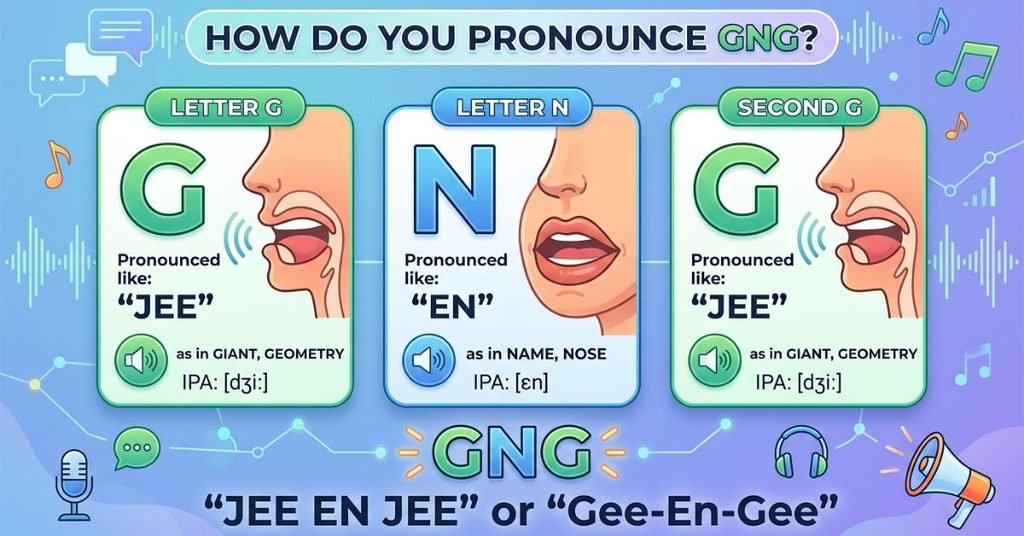
Since GNG is a written abbreviation rather than a spoken word most people grew up saying out loud, pronunciation can feel a little unclear at first. In practice, people say it two main ways:
- Letter by letter — “G-N-G,” spoken as three individual letters, similar to how you’d say “BRB” or “LOL” letter by letter.
- As the full word it replaces — many people simply read it aloud as “gang,” treating the abbreviation as a written shortcut rather than a new spoken word.
There’s no single “correct” way — it depends on the speaker and the region. In everyday conversation, most people default to just saying “gang,” since that’s the word GNG is standing in for.
Common Mistakes People Make with GNG
Because GNG carries more than one possible meaning, a few mix-ups happen often enough to be worth flagging:
- Assuming it always means “friend group.” As covered earlier, gaming communities frequently use it to mean “go next game.” Reading it as an affectionate term in the wrong setting can come across as confusing or out of place.
- Using it in formal writing. Slipping GNG into a resume, a school essay, or a work email will almost always read as a mistake rather than intentional style, since it belongs firmly in casual digital spaces.
- Overusing it until it loses meaning. Slang terms work best in moderation. Dropping GNG into every single message can make it feel like filler rather than genuine warmth.
- Confusing it with unrelated acronyms. GNG can look similar to other short strings of letters floating around the internet (GG, GN, NGL), and mixing them up mid-conversation is a common slip, especially for people newer to internet slang.
Generational Differences in Understanding GNG
One reason GNG occasionally causes confusion is that its meaning splits fairly cleanly along generational lines:
- Older generations who aren’t immersed in youth internet culture often default to the traditional, more serious meaning of “gang” — associating it with organized groups rather than friendship.
- Younger users, especially those who grew up on TikTok, Snapchat, and Discord, overwhelmingly read GNG as a warm, casual term for close friends, with little to no connection to its older, more negative connotation.
This gap explains why a parent or older relative might raise an eyebrow at a text that says “love you gng,” while a teenager reading the same message wouldn’t think twice about it. Recognizing this generational split can help avoid awkward misunderstandings, especially in mixed-age group chats or on public posts where multiple age groups might be reading along.
Quick Reference: GNG Meanings at a Glance
| Context | Likely Meaning |
| Caption or comment on TikTok/Instagram | Close friends, squad, community |
| Creator addressing followers | Their audience/fanbase, treated like a group of friends |
| Quick, casual one-on-one text | “Going” (as in heading somewhere) |
| Gaming chat after a match | “Go next game” |
| Group chat sign-off at night | “Good night, gang” |
| Formal, industry-specific document | Unrelated technical acronym (rare, context-specific) |
When in doubt, this table is a good starting point — but always let the surrounding conversation make the final call.
How to Respond to GNG
Not sure how to reply when someone sends you a “gng”? The right response usually depends on how it was used, but here are some natural ways to answer back in different situations:
If someone calls you “gng” affectionately:
A simple mirrored response works best — “love you too gng,” “always gng,” or just a heart emoji. You don’t need to overthink it; matching their energy is usually enough.
If it’s used as a greeting to a group (“what’s up gng”):
Respond like you would to any casual greeting — “not much, just chilling,” or jump straight into whatever the conversation is actually about. GNG here is just an opener, not something that needs a direct reply.
If someone comments “GNG” under your post:
A quick “🔥” emoji, “gng 💙,” or a short thank-you is enough. It’s a supportive, low-effort comment, so it doesn’t call for an essay in return.
If it appears in a gaming chat after a loss (“gng”):
This is usually a cue to move on, not a comment that needs a reply at all. If you do respond, something like “yeah let’s go” or “bet, next one” fits the tone.
If you’re unsure which meaning was intended:
It’s completely fine to ask. A casual “wait what do you mean lol” keeps things light while clearing up any confusion — better than guessing wrong and responding out of context.
If a stranger or unfamiliar account uses it:
Feel free to respond cautiously or not at all, the same way you’d treat any unfamiliar casual language from someone you don’t know well.
Final Thoughts
At the end of the day, GNG is simple once you strip away the confusion: it’s shorthand for “gang,” used affectionately to refer to your close friends or community. In gaming spaces, it can shift to mean “go next game,” and in fast-paced texting, it occasionally just means “going.” The key to understanding it — like most internet slang — is context. Look at who’s talking, where the conversation is happening, and what’s going on around it, and the right meaning will almost always be obvious.
Whether you’re trying to keep up with your kids’ texts, understand comment sections on your favorite creator’s posts, or just want to sound a little more fluent in today’s digital shorthand, now you’ve got GNG fully figured out.
Frequently Asked Questions
What does GNG mean in texting?
Within everyday text conversations, GNG typically functions as a shorthand nod to “gang,” used when someone’s chatting with their close circle or calling out to a group they’re familiar with. It carries a casual, friendly tone rather than anything formal.
What does GNG mean on social media?
Across platforms like Instagram, TikTok, and Twitter, GNG plays a similar role as a compressed version of “gang.” Depending on who’s posting, it might point to a person’s friends, their followers, or a wider community they feel connected to.
Does GNG always mean “gang”?
No. “Gang” is the most common meaning, especially on TikTok, Instagram, and in friend-to-friend texting, but it can also mean “going” in fast typing or “go next game” in gaming chats. Context decides which one applies.
Is GNG only used by Gen Z?
It’s most popular among Gen Z and younger millennials, but usage has spread widely enough that people of various ages now recognize and use it, especially anyone active on social media or in gaming communities.
Can I use GNG with people I don’t know well?
It’s best kept for people you’re already casual and friendly with. Using it with strangers or in professional contexts can feel out of place or overly familiar.
Is GNG considered rude?
Not inherently. It only risks feeling cold or dismissive when it’s sent completely alone with no other context, similar to how any one-word text can come across depending on tone.
Where did GNG originally come from?
It comes from the word “gang,” shortened through vowel deletion, and its friendly, friend-group meaning was shaped heavily by hip-hop culture, gaming communities, and youth social media trends.
Is there a difference between GNG and “gang” spelled out fully?
Not really in meaning — GNG is simply a faster, more casual written version of “gang.” Spelling it out fully doesn’t change the meaning, it just feels slightly less abbreviated and trendy.
Should I use GNG in professional writing?
No. Like most internet slang, it belongs in casual, informal spaces — texts, captions, comments — not emails, resumes, or formal documents.
What’s the difference between GNG and “gang” without vowel removal?
None functionally — it’s purely stylistic. GNG just fits the fast-paced, shorthand nature of digital communication better than the fully spelled-out version.